
What a difference 250 years makes
Nice republic you’ve got there; it’d be a shame if something happened to it

As the story goes, Benjamin Franklin was leaving the Continental Congress one day in 1787 when a lady stopped him and asked, “Well, Doctor, what have we got — a republic or a monarchy?”
Franklin answered succinctly: “A republic, if you can keep it.”
It’s pithy and appropriate, and its origin is hazy if it were ever uttered at all. The tale comes from delegate James McHenry, relating a conversation between Franklin and a Philadelphia socialite, Elizabeth Willing Powel.
Like the children’s game “Telephone Line,” later retellings add a response from Powel — “And why not keep it?” — to which Franklin is said to have replied that the people, “on tasting the dish, are always disposed to eat more of it that does them good.”
No truer words can describe what has transpired with our republic over the past 250 years, regardless of the dubious veracity of the quip’s provenance.
I imagine the Founders getting a glimpse of snapshots from over two and a half centuries and mounting loud protests. But their experiment is nothing if not resilient; generations later, we still have our republic despite near constant efforts to unravel it.
But I doubt that’s what’s on most Americans’ minds today. Given the decline in civics and government instruction over the years, with the exception of Lin-Manuel Miranda’s “Hamilton,” most people these days know little about how our nation came to be, and really don’t care to know more.
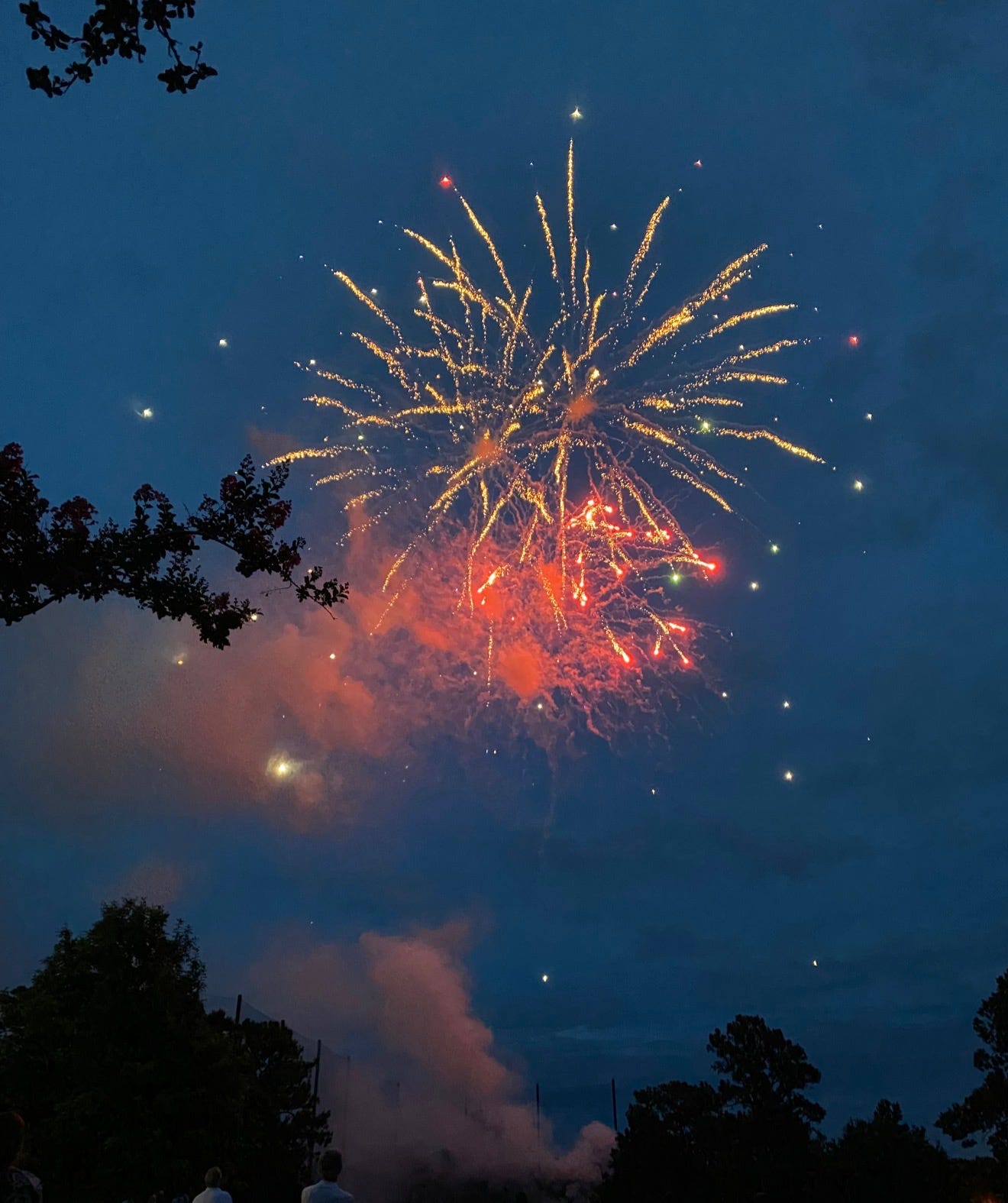
The Fourth of July means a day off from work, big sales in the marketplace, baseball, hot dogs, burgers, fireworks, and for too many, a bit too much firewater.
As a kid, I developed an interest in the writings of George Plimpton, a journalist who seemed cut from the same cloth as Walter Mitty and Forrest Gump. I was fascinated by Plimpton’s ability to tell richly woven narratives about interesting endeavors most of us would never experience. It would be years later before I realized I was drawn to storytelling and those who tell them well more than the content of the stories themselves. Plimpton soon settled into the upper ranks of my esteem.
In 2002, I heard him speak at the Alabama Writers Symposium in Monroeville, and had an opportunity to visit with him afterward. I had a few of his books that I asked him to sign, and was greatly pleased to have said something to him that literally made him double over with laughter.
Every year about this time, I remember Plimpton. It’s the fireworks — Plimpton loved fireworks, and pyrotechnics remain a common theme in many of the best anecdotes in Plimpton lore.
I, too, love fireworks, and would have blown off two or three fingers for the opportunity to burn through a couple of crates of explosives with him. There are scores of such stories collected from more than 200 friends, family members, colleagues and even some detractors in “George Being George: George Plimpton’s Life.”
As I got older, I graduated to firecrackers, then M-80s or cherry bombs, which had the added cachet of being “outlawed.” Occasionally I’d get my hands on a Roman candle, but even those were fairly boring unless you had someone to point it at.
Novelist William Styron recalled a time Plimpton invited him and his wife Rose to join him in a parade through Manhattan celebrating the Bicentennial of the City of New York. When the Styrons arrived, Plimpton welcomed them to his horse-drawn carriage outfitted with a large sign that read: “Fireworks Commissioner City of New York.”
Rose Styron tells of a gathering at the home of John Marquand several days before the Fourth of July, and how Plimpton smuggled a large cache of illegal fireworks into Martha’s Vineyard so he and his friends could set them off on Marquand’s beach. Apparently someone alerted nearby Otis Air Force Base about rockets, bombs, and missiles over the Vineyard, because soon military aircraft appeared overhead. Plimpton quickly gathered the felonious contraband and left the island.
My own experiences pale in comparison. In our neighborhood, we started out with the most pedestrian of pyrotechnics, the sedate sparkler. As I got older, I graduated to firecrackers, then M-80s or cherry bombs, which had the added cachet of being “outlawed.” Occasionally I’d get my hands on a Roman candle, but even those were fairly boring unless you had someone to point it at.
But nothing was as intriguing as the humble bottle rocket. It was a marvel of simplicity with unlimited possibility. Used as intended, an ignited bottle rocket would fly 10 to 20 yards into the air before exploding as a firecracker might. There were no splashes of color or corkscrew offshoots. It was simply “whoosh-bang!” Because they weren’t fancy, they were relatively economical compared to the more high-toned fireworks. The bottle rocket was nothing more than a thin stick attached to a tightly wrapped capsule of gunpowder. In addition to holding the ignitable part off the ground, the stick gave the projectile a small measure of stability.
Ingenious! And cheap! A few bucks would buy a sack full, which would provide a group of mischievous teenagers with an afternoon of mayhem.
I can’t count the times my friends and I would stake out positions in front of my buddy Anton’s house on Burdeshaw Street for the bottle-rocket wars. Rather than fire the missiles into the air, we would fire them at each other. It was tremendous fun for everyone except Judy, the family dog, who had enough sense to hide after the first explosion. Anton’s younger siblings and their friends would also disappear.
One day a couple of clean-cut kids in black slacks and white shirts — Latter-day Saints youth on their summer mission — rode up on their bicycles and wanted to talk about Joseph Smith and The Book of Mormon. Instead, someone aimed a bottle rocket so that it exploded just over their heads. That shot over the bow was all it took; someone handed the missionaries a couple of Bic lighters and a package of bottle rockets and the battle expanded. It was an excellent respite for those guys; after all, they were kids, too.
The whiz-bang of a bottle rocket is a lingua franca among the young at heart everywhere. An exhilarating outing with fireworks transcends cultural barriers like little else. Several years ago, I was in a group on a Rotary International Study Exchange to Hong Kong, and after several weeks in Hong Kong, a Chinese Rotarian took us into mainland China to visit a lychee farm.
Along the way, we had an overnight at a rural compound, which in itself was a leap of faith. We had no idea where we were, or in what sort of place we had been put up. The rooms were austere, almost as if they weren’t designed for lodging. And there was nothing to do except sleep before we hit the road again the next day.
As I lay on my cot looking at the ceiling, I heard some popping sounds nearby, and went outside to investigate. I found three Chinese kids along the roadway puffing on cigars. When they saw me, they weren’t sure what to make of a 6-foot, 2-inch Caucasian. Clearly they’d never seen a Westerner. But they waved me over anyway. On the dirt road was a telltale crumpled brown paper sack just like the ones we used to clutch when we’d leave the roadside fireworks stand on the outskirts of New Brockton, and I knew what was going on: these boys had some illicit Chinese fireworks. One of them handed me a cigar-like stick with a burning ember on the end, and then gave me a package of rockets. I was in my mid-30s, but in that moment I was 16 again, giddily touching the dim red glow of my cigar to fuse after fuse and watching stuff blow up. Out of the corner of my eye, I noticed someone approaching — a severe-looking man in a military-style uniform. Clearly he was some sort of authority figure. The Chinese boys and I froze, and in that moment I wondered if they were thinking the same thing I was — that we were headed for a jail cell, or worse.
The air grew tense as the guard held out his hand as if to confiscate. One of the boys meekly offered the sack. The guard waved him off, and pointed to a cigar. The boy handed him the cigar and the guard took a package of fireworks from the bag and began launching his own fusillade, grinning broadly as the rockets flew away and exploded.
I’m reminded of a time when authority figures interrupted one of Plimpton’s pyrotechnic interludes. He was once again blasting fireworks in Martha’s Vineyard, where the pedigreed New England bluebloods play, and this time he had some high-profile guests, including U.S. Sen. Teddy Kennedy. That didn’t stop the police from manhandling Plimpton into cuffs and then into the back of a squad car, whisking him off to the pokey. Kennedy had an attorney with him, and sent the lawyer off to bail Plimpton out.
He should have considered handing the officers cigars and packages of bottle rockets. The story might’ve had a different ending.
Years ago we spent the 4th at Lake Eufaula. A couple of young boys were next door-they called Art “the firecracker man!” He loved them, even bought some big ones requiring mortars to shoot them. 😳🤣
FUN! Happy 4th! 🎆🇺🇸🇺🇸🇺🇸
So glad we didn't burn the house down, says an adult Anton